F&L TECHNICAL SALES INC.
  • Home
  • About
  • Principals
    • Better Edge
    • Blue Photon
    • Dorian Tool
    • Hannibal Carbide
    • Heritage Cutter >
      • Brubaker
      • Data Flute
      • Decatur Diamond
      • Weldon
    • Hirt Line
    • Horn USA
    • Mate Workholding
    • Platinum Tooling
    • Rocky Mountain Twist
    • Techniks Group >
      • Techniks
      • Parlec Inc.
  • News
  • Contact
    • Promotions

Eliminating Steps: Drilled Deburred & Back Chamfered with ONE EZ Burr Tool

8/12/2020

1 Comment

 
The Challenge 
The challenge was to achieve both hard and soft cost savings, as well as time spent on drilling flanges from one side, chamfering the backside and creating a controlled chamfer on the top surface which was a secondary process.
EZ Burr DRILLED DEBURRED & BACK CHAMFERED WITH ONE EZ BURR TOOL.jpg
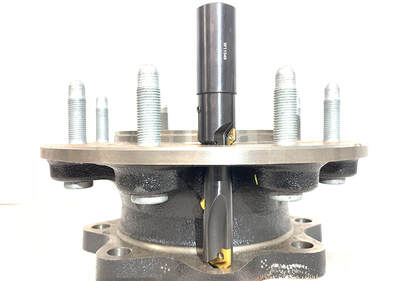
Drill, Deburred & Back Chamfer EZ Burr Tool being used in a Wheel Hub Extender
Application
Hub Extender

Material
Cast Iron

Tool
Burr-Free Drill
The Solution
We designed an indexable drill with our rear cutting carbide deburring insert along with a fixed pocket chamfer insert to create the precision top chamfer that was required. The spade drill insert also had a special feature that allowed it to chamfer the top side of the bottom hole that was pre-drilled.

The Results
​Four operations were completed in one pass.

The EZ Burr Burr-Free Drill drilled the hole, deburred and chamfered the back all in one step, thus eliminating the secondary step of chamfering the bottom surface on the top hole.

This saved time as well as money, plus the tool life of the Burr-Free Drill achieved a more consistent result and had a longer tool life than the previous method.
1 Comment

Workholding for High Accuracy Medical Device Machining

7/14/2020

0 Comments

 
This article is about Blue Photon Technology and Workholding Systems LLC  and how Post Processing; 3D printing presents challenges in workholding for finish machining.
Written by Mark Kirby AM Business Manager, Renishaw Canada
Metal 3D printing can enable rapid, low cost iterations of new medical devices, since no tooling costs are involved. All devices need testing to uncover problems and develop solutions—allowing the product shape to change “for free” is a powerful advantage with Additive Manufacturing (AM). Other benefits flowing from AM besides enabling more complex geometry are improved accuracy with no component tolerance stack up, and a simplified supply chain with reduced part count.
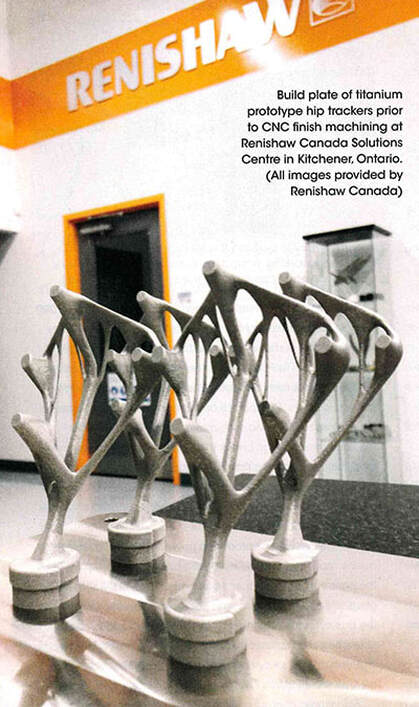
Prototype Hip Trackers workholding
Printing is usually not the end of the process. Almost always, after printing and any heat treatment, metal parts require some machining in a few areas.

Sometimes to improve surface finish, more often to allow fasteners to lock the component in place. For example, spinal clamps can expand with living hinges, or a captive ball and socket can be printed as one and locked with a set screw.

In both cases the threads required will be machined rather than printed. If machining is only required in one direction, then parts can sometimes be machined on the build plate. Usually machining is required from multiple directions and it is impossible to access these areas with multiple parts printed on the plate.

The workholding challenge is then how to best hold the component for machining after it is removed from the build plate.

3D Printed Workholding

Plastic printed jaws are often a good first option, as they are cheap to manufacture—typically in just a few hours on a desktop printer, and can conform to complex geometries (although the design of the jaws can be more time consuming than a simple Boolean subtraction of the component from the plastic). When the design changes after product testing it is easy to print a new set of jaws.
​

The main disadvantage of plastic jaws is that they will often distort the component as they are tightened. Although the jaws hold the part rigidly for machining, when the component is released from the fixture any machined bores may no longer be perfectly round, and true positions of features will have moved slightly as the component relaxes back into its unloaded shape.
A recent collaborative project involving Renishaw, University of Waterloo and Intellijoint Surgical investigated a printed alternative design for an optical tracker used in total hip arthroplasty. The tracker provides surgeons with intraoperative measurements, enabling proper establishment of cup position, equalization of leg length and restoration or maintenance of offset and joint center of rotation.
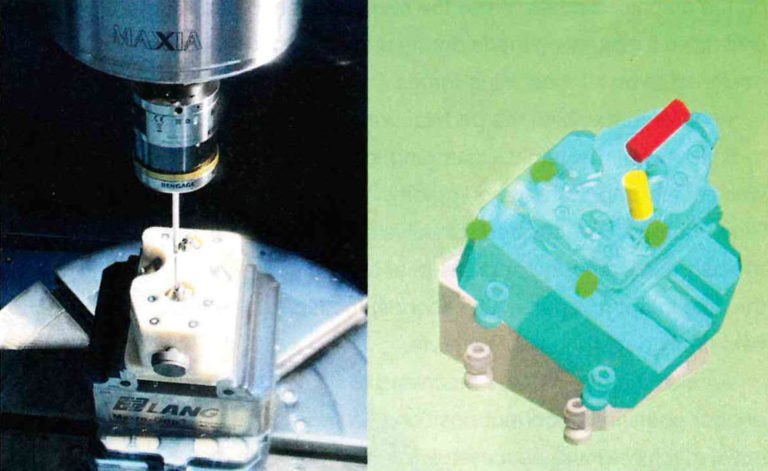
Hip Trackers-Renishaw Fixturing
Plastic conformal jaws and best fitting coordinate transformation performed by NC-PerfectPart software after CNC probing.
The tracker body was monolithically printed in titanium alloy  Ti6-4, stress relieved and then cut from the build plate ready for finish machining of the kinematic mount and the four posts that hold the optical reflector globes.
​

A plastic set of jaws was designed to clamp the part while leaving the machining areas exposed. Although the plastic jaws clamp the part rigidly, they never clamp the part repeatably, so the exact position of the part must be found using a machine probe and best fitting software such as NC-PerfectPart, from Metrology Software Products Ltd. (MSP). Originally developed for machining of high value aerospace and Formula 1 composite structures, this software is perfectly suited to the challenge of precisely locating an organic-shaped AM part with no obvious datum features.

Points are selected on the component in the CAD environment and the deviations from nominal positions are measured by the probe on the CNC machine. The NC-PerfectPart software then creates a best fit alignment that is a 6-axis coordinate transformation—both translation and rotation. This coordinate shift is automatically recalled into the machine controller before CNC programs are executed.
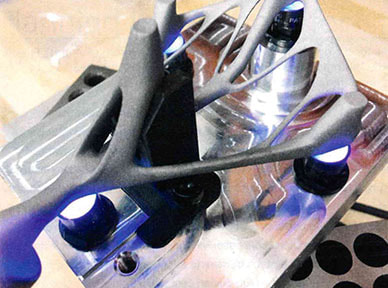
Hip Trackers-Renishaw
Hip tracker being adhesively bonded to Blue Photon grippers using UV light. This solution holds the part rigidly but without the distortion caused by clamping forces from plastic jaws.
The machine probe is also used to automatically achieve very high tolerances by employing a “cut/measure/cut” strategy.

Features are semi-finished, measured and compensation automatically applied to achieve tight drawing specifications on final machining passes.

​This approach allows for variables such as cutter/part deflection under load, and tool variation from programmed size.

Problems and Solutions

Unfortunately, the hip tracker component flexed imperceptibly when the plastic jaws were clamped, resulting in true position errors greater than 0.3mm on the machined posts. While the component had been optimized for handling loads during surgery, it had not been designed to resist machining forces.
In order to machine the part accurately it was essential not to bend it with mechanical clamping, but at the same time it was equally important to add rigidity.

The solution was to use Blue Photon’s UV activated adhesive and grippers. By gluing the part onto four gripper posts (that transmit UV light to cure the glue in approximately 90 seconds) the hip tracker was held firmly but still in the free state.

An aluminum block was machined to hold the four gripper posts in the correct positions for the tracker body. Initial machining was successful on the three posts directly bonded to the grippers, but one post was cantilevered above the gripper and vibrated during machining. A plastic support block was printed to hold this post and eliminated this problem. By cradling the part, the support block also allowed for more accurate positioning of the tracker prior to the glue being cured. The glue thickness is optimally around 1mm, and after machining the part and fixture can be separated by simply immersing the assembly in near boiling water for a few minutes, and then peeling apart.

The only disadvantage of using the glue grippers appeared to be the extra work to design and machine the gripper fixture. However, on a subsequent project for an industrial impeller Renishaw used plastic printing to produce the gripper fixture instead of machining. This proved that the manufacture of a robust, custom workholding solution can be reduced to an overnight desktop print.

Refining the Procedure:
​Generative Design

An improved workflow for producing glue gripper fixtures is to use generative design software, such as Autodesk’s Fusion 360. It would automatically create the connections required between the grippers and for example a chuck that will hold the fixture on the CNC machine.
Cranial Plate workholding
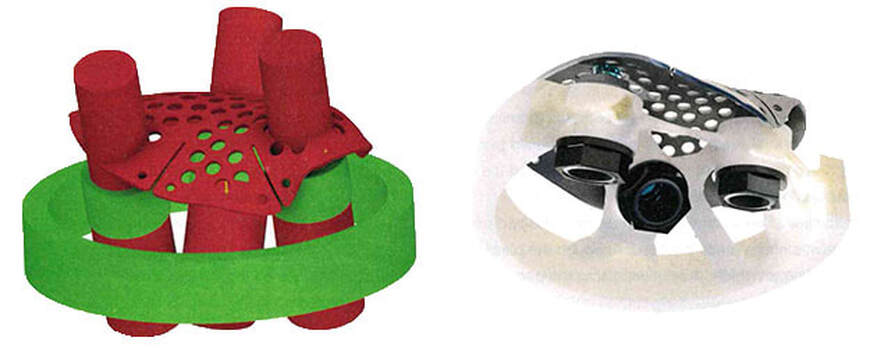
Workflow for automatic design of a Blue Photon fixture for a cranial plate. Generative design workspace (Autodesk Fusion 360) shows green preserve and red obstacle geometry. This process requires no expert CAD design time and will automatically be optimized to maximize stiffness under the applied machining loads.
The procedure for a patient specific medical device like a cranial plate would be as follows. The number and placement of the grippers would be determined by the manufacturing engineer. “Preserve” regions would then be defined around each gripper as a cylindrical “bushing” with obstacle clearance regions extruded axially above and below each gripper to allow for insertion and captive nut placement.

​The cranial plate is also defined as an obstacle that must be avoided. A preserve ring would be defined, and constrained, to enable the completed fixture to be held in a chuck. Loads are added to the gripper bushing preserve regions to represent machining forces that must be resisted. The software can then solve the structural connection of all the parts for maximum stiffness.

One of the barriers to adoption of patient specific solutions is the high design cost typically involved. Using generative design coupled with plastic printing is an innovative solution that largely automates the workholding process with Blue Photon’s adhesive grippers.
0 Comments

Meeting Stringent Requirements Deburring Ribs in a High Silicon Aluminum Engine Block

5/20/2020

0 Comments

 
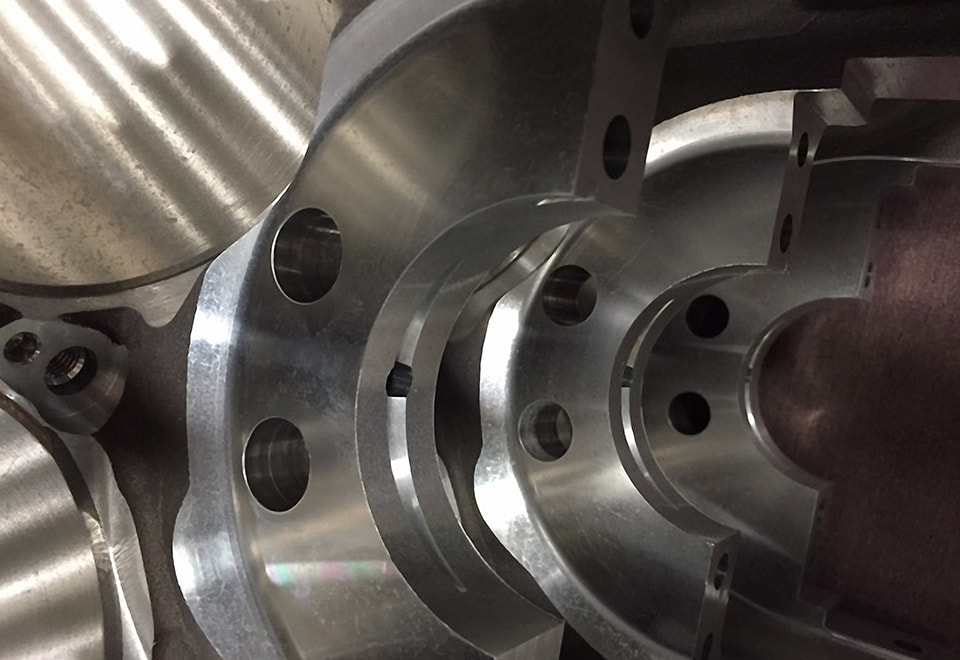
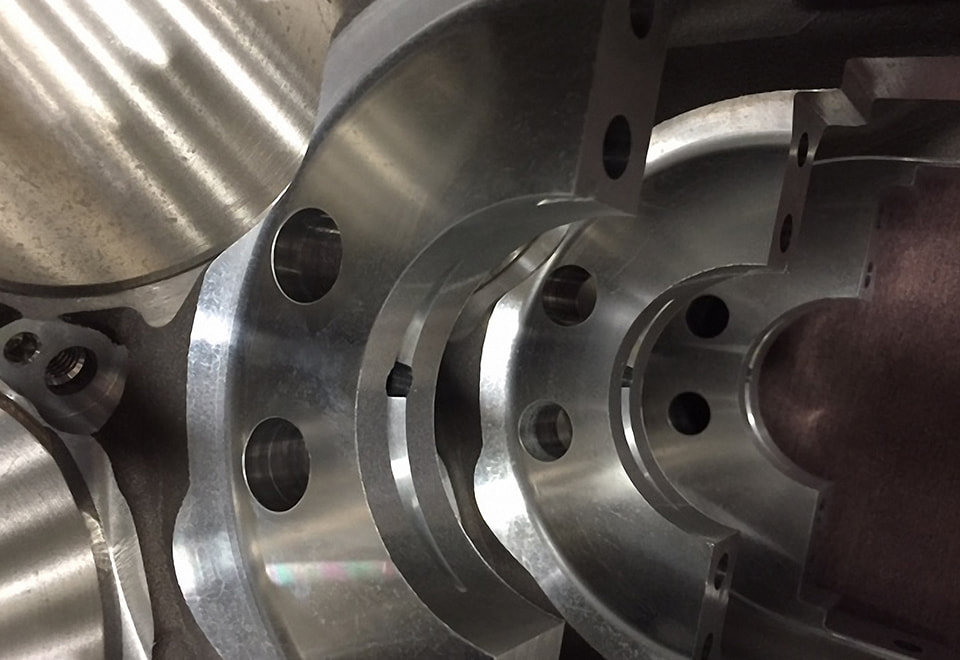
EZ Burr Case Study ALuminum Engine Block Deburring Long reach
EZ Burr was tasked with deburring a series of internal ribs in a very long high-silicon aluminum engine block. A special extra-long (14” OAL) Carbide Series tool with a rear cutting only inserts was required to get down into the internal ribs for the deburring. 

​If that where the only parameters to that need to be met it would be a challenge.  The customer also needed cycle time to remain at 12-15 seconds while running at 1250 RPM and 15.750" IPM. 

EZ Burr had to make an extra length tool that could handle these cutting conditions without adding any cycle time to the process. The insert had to produce a clean, smooth surface and run a consistent number of blocks each and every shift.

The initial testing resulted in a built up cutting edge on the inserts. EZ Burr's solution involved working closely with thier coating vendor to apply the perfect coating to the inserts to get the desired results.

​In the end, the tool design, cycle time and performance all met the stringent requirements as specified by our customer. We also made sure to always have a batch of these specially coated inserts ready for release at our local distributor, and enough long reach arbors on hand at EZ Burr to have ready to deliver in less than 2 weeks.
If you have an unique deburring application, get in contact with one of our F&L Technical Sales team members!  We'd love to help you out!
Contact F&L Technical Sales Team
0 Comments

E-Z Burr Custom Carbide Tool Helps Skyway Precision Save 20 Minutes per Part

12/12/2018

0 Comments

 
Case Study: E-Z Burr
E-Z Burr Custom Carbide Tool Helps Skyway Precision Save 20 Minutes per Part
Skyway Precision Inc. is a comprehensive CNC World Class Machining operation, located in Plymouth Michigan. It is Skyway’s commitment to provide their customers with experienced machining processes and quality products that are delivered on time with an industry competitive cost. Established in 1968, Skyway prides itself by making their mark on the preferred supplier list of many major global manufacturers and has forged a reputation as an industry leader in the production of machined components.
The Burring Problem:
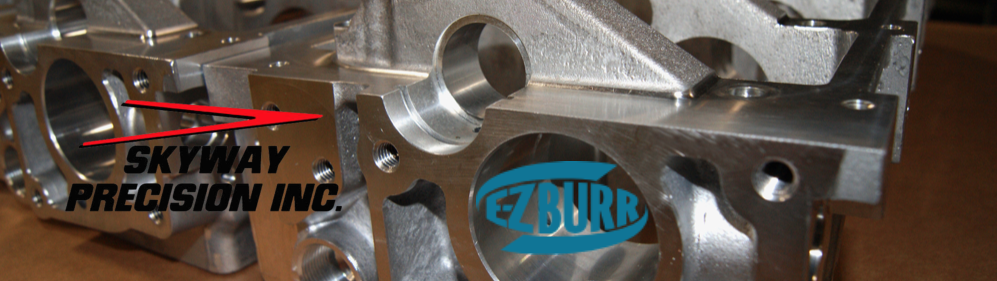
After working with Skyway on several projects, they asked E-Z Burr to provide a solution to a deburring challenge to reach the backside of a large 80lb component. The Nodular Iron component is an 11.6 inch Hub with 22 holes, 10 @ .425 diameter and 12 @1.093 diameter.

Skyway was removing the 80lb hub from the Hyundai-Kia Hi-V50D machine, and placing it on the workbench to manually deburr the rear of the holes by using a countersinking tool in an air drill. This method proved to not only be cumbersome, but also time consuming and costly.

The weight of the hub required heavy lifting and positioning while performing this secondary operation by hand on the workbench. The extra handling required further man-hours and was a challenge in maneuvering.

In addition, the countersink tool was expensive, and the life of the tool was very limited. The tool would wear quickly and required re-sharpening or replacing often. This extra operation was an added cost to the machining process.
Solution:
The E-Z Burr Carbide Series Tool offered Skyway a variety of options designed to do the rear of the holes while the hub was still in the machine.

“While we have a standard selection of diameters and lengths available off the shelf, we designed a special 9” long tool for this unique application. “The tool was tested at 550 RPM @ 8.8 IPM (1.087 hole), to accommodate their specifications”, says Robinson.

“This gives them the ability to deburr the backside of the hole efficiently while the hub remains in the machine.”

For the smaller holes on the hub, a standard length tool at 1750 RPM @ 11 IPM (.425 hole) is used to deburr both the top and bottom all in one economical pass. Skyway prefers to use the more aggressive E-Z Burr carbide insert that is also a standard option. The increased angles and positive cutting features provide just the right amount of pressure and engagement to produce the desired chamfer.
Results:
The introduction of the E-Z Burr Tool to the process eliminated the need to remove the part from the machine to do the rear of the holes. The danger and additional manpower was dramatically reduced with the new process.

In addition, the time spent using the countersinking tool and the cost associated with the tool were eliminated and resulted in more profit to the bottom line.

Eliminating the need to remove and transfer the part created a safer working condition for the machine operators and a better job quality allowing the operator to focus on performance while meeting production schedules.

This solution led to productivity, saving Skyway 15 to 20 minutes per part. While the countersinking tool would last a day or two, the E-Z Burr carbide insert proved to run a month before the need of replacement. The tool itself remained in the machine while the insert was being replaced adding to the ease of use and gained efficiency in manufacturing.

This process then led to further engineered improvements by using a short pilot drill to start the hole and chamfer the top of the large holes. The pilot hole eliminated the “walking” and breakage problems and prolonged the life of the expensive long drill to perform its function.

“E-Z Burr prides itself on more than just providing superior deburring tools. We get involved with our customers to solve production problems where deburring parts are an important measure in the final product,” says Robinson. “Problems should not be a roadblock and time is a precious commodity in production. We have the ability to accommodate tight timelines of days or weeks. The particular tool we customized for Skyway was designed and delivered in less than 2 weeks.”
0 Comments

EZ Burr Meeting Stringent Requirements in High Silica Aluminum.

4/18/2018

0 Comments

 
CASE STUDY: EZ Burr visits GM Romulus deburring internal ribs in a very long engine block.
ezburr-case-study-gm-romulus
  • Application: Large automotive engine block made from high-silicon aluminum
  • Material: High Silicon content aluminum
  • Tool: A special extra-long (14” OAL) Carbide Series tool with a rear cutting only inserts
  • The Challenge: To deburr the series of internal ribs in a very long aluminum engine block.

The speed & feed is 1250 RPM @ 400 mm/min.; cycle time 12-15 seconds.
EZ Burr had to make an extra length tool that could handle these cutting conditions without adding any cycle time to the process. The insert had to produce a clean, smooth surface and run a consistent number of blocks each and every shift.

  • The Solution: The initial testing resulted in a built up cutting edge on the inserts. The EZ Burr solution involved working closely with our coating vendor to apply the perfect coating to the inserts to get the desired results.
  • The Results: The tool design, cycle time and performance all met the stringent requirements as specified by our customer. EZ Burr made sure to always have a batch of these specially coated inserts ready for release, and enough long reach arbors to have ready to deliver in less than 2 weeks.

0 Comments

    ABOUT

    This is where we publish technical articles, applications stories, tip and tricks, new product announcements and press releases.

    Archive

    August 2025
    July 2025
    June 2025
    May 2025
    April 2025
    March 2025
    February 2025
    January 2025
    December 2024
    November 2024
    October 2024
    September 2024
    August 2024
    July 2024
    June 2024
    May 2024
    April 2024
    March 2024
    February 2024
    January 2024
    December 2023
    November 2023
    October 2023
    September 2023
    August 2023
    July 2023
    June 2023
    May 2023
    April 2023
    March 2023
    February 2023
    January 2023
    December 2022
    November 2022
    October 2022
    September 2022
    August 2022
    July 2022
    June 2022
    May 2022
    April 2022
    March 2022
    February 2022
    January 2022
    December 2021
    November 2021
    October 2021
    September 2021
    August 2021
    July 2021
    June 2021
    May 2021
    April 2021
    March 2021
    February 2021
    January 2021
    December 2020
    November 2020
    October 2020
    September 2020
    August 2020
    July 2020
    June 2020
    May 2020
    April 2020
    March 2020
    February 2020
    January 2020
    December 2019
    November 2019
    October 2019
    September 2019
    August 2019
    July 2019
    June 2019
    May 2019
    April 2019
    March 2019
    February 2019
    January 2019
    December 2018
    November 2018
    October 2018
    September 2018
    August 2018
    July 2018
    June 2018
    May 2018
    April 2018
    March 2018

    Categories

    All
    52/96 Workholding
    Adhesive Workholding
    Aerospace Manufacturing
    Allen Benjamin
    ATC Alignment
    Better Edge
    Blue Photon
    Blue Photon Grip Pallet
    Boring
    Broaching
    Brubaker Tool
    BT Holders
    Carbon Fiber
    Case Study
    CAT Holders
    Chamfering
    Citizen
    Coating: Blue NACo
    Coatings
    Collet Nut
    Collets
    Collets: Lathe
    Composite Machining
    Coolant Lines
    Countersink
    Dataflute
    Dead Centers
    Deburring
    Decatur Diamond
    Definitions
    Diamond CVD
    Diamond PCD
    Dorian Tool
    Drilling
    Eastec
    Eccentric Turning
    End MIll
    EZ Burr
    Face Milling
    Fixturing
    F&L Technical Sales
    Fretting
    Geometry
    GMN Spindle
    Graphite Machining
    Grooving
    Guide Bushings
    GWS Tool Group
    Hannibal Carbide
    Heimatec
    Henninger
    Heritage Cutter
    High Speed Whirling
    Hirt-Line
    Hommel + Keller
    Horn FIrearms Tooling
    Horn Supermini
    Horn USA
    Hydraulic Toolholder
    IMTS
    Inserts
    JET Whirling
    ​Knurl Cutting
    ​Knurl Cutting
    Knurl Forming
    Knurling
    Live Centers
    Live Tooling
    Mate Workholding
    Medical Device
    Medical Manufacturing
    MegaFORCE
    Miyano
    Modern Industries
    ModLOC
    MPower
    Nexturn Swiss
    North American
    Parlec
    Part Marking
    Platinum Tooling
    Polygon Turning
    Practical Machinist
    Promotions
    Pull Studs
    Rapid Edge Program
    Reamers
    Recondition
    Retention Knobs
    REV Broaching
    RMT Rocky Mountain Twist
    RMT - Rocky Mountain Twist
    Routers
    Screw Threads
    ShrinkLOCKED
    Slot Cutting
    Slot Milling
    SpeedLOC
    Spindle Repair
    Spindle Speeder
    Spindle Wear
    Swiss
    Taps
    Taps: Bottom
    Taps: HSSE
    Taps: Plug
    Taps: Roll Form
    Taps: Taper
    Techniks
    Techniks SPINner
    Technocrats
    Tech Tip
    Tecnicrafts
    Threadmilling
    Toolholders
    Triton Chucks
    Troubleshooting
    Turbo-Whirling
    Turn Whirl Milling
    Turret
    USMTO
    Weldon Flat
    Weldon Tool
    Workholding
    Workholding Jaws
    Zero Point

    RSS Feed

Home
About
Principals
Contact
F&L Technical Sales Logo Square
F&L Technical Sales Inc.
326 Woodland Way
Russell, MA 01071
Established 1999
© 2024 F&L Technical Sales Inc.
All Rights Reserved
site design: Rapid Production Marketing
  • Home
  • About
  • Principals
    • Better Edge
    • Blue Photon
    • Dorian Tool
    • Hannibal Carbide
    • Heritage Cutter >
      • Brubaker
      • Data Flute
      • Decatur Diamond
      • Weldon
    • Hirt Line
    • Horn USA
    • Mate Workholding
    • Platinum Tooling
    • Rocky Mountain Twist
    • Techniks Group >
      • Techniks
      • Parlec Inc.
  • News
  • Contact
    • Promotions